
Many finishing problems start with one thing: poor adhesion. Plaster that sounds hollow and detaches from blockwork, a new pour that separates from old concrete with a crack between them, or a repair that falls off after a few months. In most of these cases the answer is a concrete bonding agent. This guide explains when you need one, how to use it, and the difference between Al-Madina Bond and Al-Madina Bond Plus.
What is a concrete bonding agent?
A bonding agent is a milky-white polymer liquid that turns clear when dry. It forms an adhesive bridge between two surfaces: old and new concrete, blockwork and plaster, or an old floor and a new screed. Added to mortar, it improves cohesion, flexibility and water resistance, and reduces shrinkage cracking.
When do you need one?
- Bonding old to new concrete: extending slabs or columns, casting next to existing concrete, or at cold joints.
- Plastering on blocks or smooth concrete: to prevent hollow, detached plaster.
- Concrete repair: spalled areas, honeycombing, cracks, and covering treated exposed rebar.
- Screeds and floors: bonding a new screed to an old slab.
- Before gypsum or tiles: to improve grip on smooth surfaces.
- As a primer before waterproofing: in tanks, pools and roofs.
Al-Madina Bond vs Bond Plus
| Item | Al-Madina Bond | Al-Madina Bond Plus |
|---|---|---|
| Grade | General-purpose bonding agent | Advanced polymer-reinforced formula |
| Best for | Plaster, screeds, surface prep before gypsum and tiles, routine repairs | Critical cold joints, high-strength repair mortar, areas exposed to water and salts |
| Waterproofing | Improves mortar moisture resistance | Enhanced waterproofing; works as a primer before waterproofing systems |
| Abrasion and chemical resistance | Good | Enhanced against abrasion, salts and chemicals |
| Pack | 20 L | 20 L |
Rule of thumb: for everyday plastering and finishing, Al-Madina Bond does the job at a lower cost. For structural old-to-new concrete, column and slab repairs, or wet areas, choose Bond Plus.
How to bond old concrete to new
1. Prepare the old concrete
Break out weak, loose concrete down to a sound base, roughen the surface (chisel or grinder), and remove dust and oil. A smooth surface will not bond well even with a bonding agent.
2. Pre-wet
Dampen the old concrete and remove standing water: damp, but no puddles.
3. Apply a bonding slurry
Mix the bonding agent with water and cement into a thick slurry at the ratio printed on the pack, and scrub it into the old surface with a stiff brush.
4. Cast while the slurry is still tacky
Place the new concrete or mortar while the bonding coat is still wet (wet-on-wet). If it dries completely, adhesion drops and you should re-apply it.
5. Cure
Keep the new concrete moist for several days, especially in summer, to limit shrinkage and cracking.
Using bond as a mortar and plaster additive
Al-Madina Bond or Bond Plus replaces part of the gauging water in the mortar, at the ratio recommended on the pack. Benefits:
- Stronger plaster adhesion to blocks and smooth concrete.
- More flexibility and fewer hairline cracks.
- Better moisture resistance in bathrooms, kitchens and façades.
- Higher cohesion in screeds and tile adhesive.
On very smooth blocks or concrete, apply a spatterdash coat mixed with bond first and let it set before the main plaster coat.
Common mistakes
- Letting the bonding coat dry completely before casting or plastering.
- Applying it on dusty surfaces or over formwork release oil.
- Adding too much water and weakening the effect.
- Relying on bond over crumbling concrete instead of removing it.
- Skipping curing of the new concrete.
Related reading: What Is Sika Latex and How Is It Used?
FAQ
Does a bonding agent replace roughening the old concrete?
No. Roughening and removing weak material are essential; the bonding agent completes the preparation, it does not replace it.
Is a bonding agent a waterproofing product?
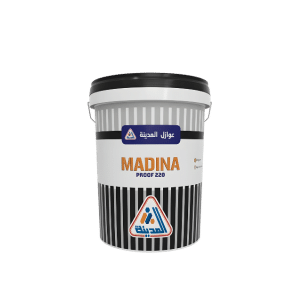
It improves mortar water resistance, and Bond Plus can be used as a primer before waterproofing systems. It does not replace a proper membrane such as Al-Madina Proof 220.
Can I use bond with gypsum?
Yes, it is used to prepare smooth surfaces before gypsum so that it grips properly.
Order bonding agents from Top Building
Al-Madina Bond 20 L and Al-Madina Bond Plus are available at Top Building with delivery across Saudi Arabia. Contact us on WhatsApp if you need help choosing the right product for your job.