Bathroom leaks usually show up years after tiling: damp stains on the ceiling below, peeling paint on the next wall, or a musty smell that never goes away. Fixing them means breaking tiles and redoing the waterproofing, so choosing the right product before tiling is the most important step in a bathroom fit-out. This guide compares two common systems: liquid rubber Al-Madina Proof 220 and cementitious Al-Madina Proof 550.
Liquid rubber vs cementitious waterproofing
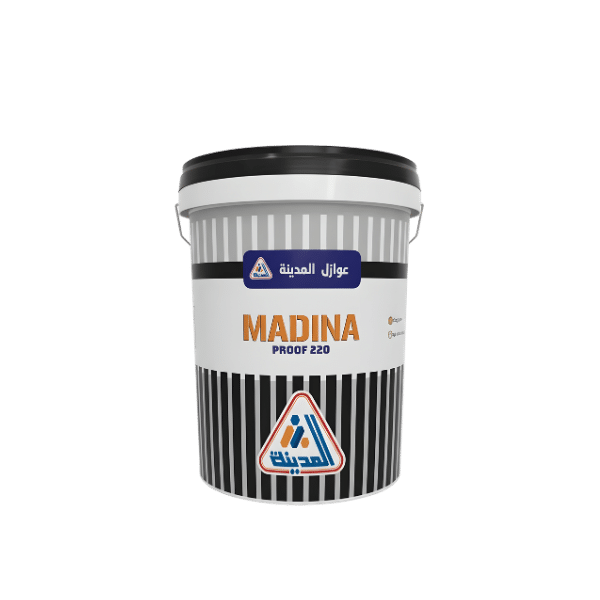
Liquid rubber (Proof 220) is a ready-to-use, acrylic-based coating with a high rubber content. It dries into a seamless, flexible black membrane that bridges hairline cracks and building movement.
Cementitious waterproofing (Proof 550) is a two-component system: a special cement powder and a concentrated acrylic polymer liquid. Once mixed, it forms a hard layer that bonds to concrete and withstands constant water immersion.
| Item | Proof 220 (liquid rubber) | Proof 550 (cementitious) |
|---|---|---|
| Composition | Single component, ready to use | Two components: powder + polymer liquid |
| Colour | Black | White or grey |
| Flexibility | Very high | Moderate (polymer-modified) |
| Coats | 3 (first diluted 5%) | At least 2, at right angles |
| Thickness / consumption | ≈1.4 kg/m² at 500 µm dry film | Minimum 1 mm total |
| Potable water | Not intended | Suitable (tested by NRC Egypt) |
| Best for | Bathroom and kitchen floors under tiles, planters, metal roofs | Water tanks, pools, basements, bathrooms, balconies |
Which one should I choose?
- Standard apartment or villa bathroom: Proof 220 is quicker and easier to roll on, and its flexibility protects against small floor cracks.
- Bathroom above a bedroom, or a floor with movement: liquid rubber, for its higher flexibility.
- Water tank or swimming pool: Proof 550, designed for permanent immersion and safe for drinking water.
- Basement or a wall with damp from behind: cementitious, as it handles positive and slight negative water pressure.
How much do I need for a 5 m² bathroom?
Add the floor area to a 30 cm upstand around the walls (and the full shower area up to about 1.8 m). A 2 × 2.5 m bathroom has 5 m² of floor plus 9 m × 0.3 m = 2.7 m² of upstand: roughly 8 m² excluding the shower.
- Proof 220: about 0.71 m² per kg at 500 µm dry film (data sheet), so roughly 11–12 kg for 8 m². A 20 kg pail covers an average bathroom; a 5 kg pack is also available.
- Proof 550: 1 mm thickness is roughly 1.7 kg/m² based on the mix density, so about 14 kg for 8 m². One 20 kg set covers an average bathroom.
Applying liquid rubber (Proof 220)
1. Prepare the floor
Remove loose cement and debris, clean off dust and oil, fill cracks and check the slope towards the drain.
2. Detail corners and pipes
Form a mortar fillet where the floor meets the wall, and reinforce corners, pipe penetrations and the floor drain with mesh tape between coats.
3. First coat
Dilute with 5% water and apply a primer coat by roller or brush.
4. Second and third coats
After about 5 hours (recoat time at 25 °C), apply two undiluted coats at right angles, running at least 30 cm up the walls.
5. Flood test
After 24 hours of full curing, plug the drain and flood the floor with 3–5 cm of water for 24–48 hours. If no damp appears below, start tiling.
Applying cementitious waterproofing (Proof 550)
- Clean off oil, laitance and release agents; keep the surface as flat as possible.
- Soak the concrete until saturated, then remove standing water (saturated surface dry).
- In a pail of at least 20 L, pour in the liquid first, then add the powder slowly while mixing with a slow drill (400–500 rpm) for 2 minutes until lump-free. A 20 kg set is 3 kg liquid + 17 kg powder.
- Brush on the first coat, wait at least 8 hours, then apply the second at right angles for a total of at least 1 mm.
- Use the mix within about 90 minutes and never add water after mixing.
Common mistakes
- Waterproofing the floor only, without turning up the walls.
- Not reinforcing the floor drain and pipe penetrations.
- Tiling before full curing or without a flood test.
- Damaging the membrane while tiling or fixing sanitary ware.
- Applying a single coat to save material.
Related reading: Bitumen Foundation Waterproofing: The Right Method and Number of Coats with Al-Madina AL-70
FAQ
Can I tile directly over liquid rubber?
Yes, once it is fully cured and the flood test has passed. A thin protective mortar layer or a suitable tile adhesive helps protect the membrane during tiling.
Is liquid rubber suitable for drinking-water tanks?
Proof 220 is not intended for potable water. Use Proof 550, which is tested for contact with drinking water.
How many coats does a bathroom need?
Three coats of liquid rubber (first diluted 5%), or at least two coats of cementitious coating totalling 1 mm or more.
Order bathroom waterproofing from Top Building
Al-Madina Proof 220 and Al-Madina Proof 550 are available at Top Building with delivery across Saudi Arabia. Send us your bathroom dimensions on WhatsApp and we will recommend the right product and quantity.